

A message from our Clinical Director, Jillian.

Let's talk about Hip & Knee Replacements...
If you're beyond middle age, chances are you know someone who has had a joint replacement or is waiting for one. Maybe it's you! Typically a total hip or knee replacement is offered to those in their 60s or 70s who have osteoarthritis (OA) causing significant pain and limited mobility that has not improved with a non-surgical approach.
The good news is that the majority of people who have surgery report significant improvements in their daily lives. But there are some who have a harder time recovering and regaining their mobility after surgery. Let's separate truth from myth so that you or your loved one are ready for the rehab journey!
Key truth: exercise matters before and after surgery
Research and clinical practice guidelines support early, progressive rehabilitation after joint replacement and show that prehabilitation (exercise and education before surgery) can improve strength/function and may improve some early post-op outcomes.
- Prehab (before surgery) — build your strength, balance & walking so you can go into surgery stronger, steadier, and more confident.
- Post-surgery rehab — control swelling, improve joint mobility, build strength, functional mobility & balance so you can get back to doing what you love.
Consistently performing & progressing your exercises after surgery will pay dividends to your future mobility. Stay accountable & commit to the journey!
Let's bust some myths around osteoarthritis (OA) and joint replacements
Myth #1: “If it hurts during exercise, you're damaging the joint.” More accurate: pain doesn't always mean harm — OA symptoms can flare with stress, sleep, weather, and activity changes. A helpful guideline is the 24-hour response: mild/moderate discomfort that settles back to baseline within 24 hours is often acceptable; pain/swelling that ramps up and lasts into the next day means reduce the dose. Most exercises can be modified as needed.
Myth #2: “Squats & stairs ruin your knees and cause OA.” More accurate: when they're scaled to your current level (depth, load, tempo, support), squats and sit-to-stands are often knee-friendly strengthening that can improve pain and function. Strong leg & hip muscles are essential in managing OA.
Myth #3: “Running causes knee OA.” More accurate: recreational running is not automatically “bad for knees.” Risk is higher when there's a history of significant injury, big spikes in training volume, poor recovery, or pain/swelling that's repeatedly aggravated and ignored.
Myth #4: “You should avoid impact exercises forever if you have OA.” More accurate: many people with OA can tolerate some impact (walking, hills, small jog intervals) when it's introduced gradually and progressed slowly. The right dose matters. Modifying exercise or using walking poles can make a huge difference in offloading the joints as well.
Myth #5: “Cartilage is like a brake pad — exercise just wears it out faster.” More accurate: joints are living tissues that respond to load. Strengthening helps the muscles share load and can improve movement efficiency and confidence.
Myth #6: “If your X-ray is 'bone-on-bone', you shouldn't exercise.” More accurate: imaging changes don't always match symptoms. Many people with significant OA findings do very well with appropriately modified exercise.
Myth #7: “After a joint replacement, you can't be active again.” More accurate: most people return to an active lifestyle with walking, cycling, swimming, and strength training. Your surgeon/physio will guide timing and any sport-specific precautions.
Myth #8: “After a knee replacement you can't kneel (ever).” More accurate: while it will take time, kneeling is possible (and I would argue necessary!), but it can feel uncomfortable due to scar sensitivity/numbness, stiffness, and fear. With surgeon clearance, gradual practice (with cushioning and support) plus desensitization it can get better — and although not everyone finds kneeling comfortable, it's important to know it is not harming your knee. Being able to get on and off the floor is a critical step in reducing your falls risk and enjoying your independence for years to come!
Consistency is Key!
When it comes to joint replacements, one thing is certain: Consistency is Key! Many people benefit from the accountability our team can provide to get them on the right track while they're waiting for surgery or moving them towards their mobility goals long after surgery.
Our PhysioCare at Home team can help. Call us today! Get an individualized Assessment & Treatment Plan with one of our amazing Therapists today, so we can help you reach your goals and improve your mobility, strength, and independence.
To Your Health,
Jillian
Physiotherapist & Clinical Director

Consistently performing & progressing your exercises after surgery will pay dividends to your future mobility. Stay accountable & commit to the journey, because Consistency is Key!
Therapist's Corner
Use 'prehab' to build leg and hip strength (2–3 days/week), improve balance and walking confidence (most days), & prepare your home and routine (one-time setup). Always follow your surgeon & physiotherapist's instructions — surgical approach, wound healing, weight-bearing status, and precautions may vary.
- Swelling & circulation: ankle pumps, pedaling, and joint range-of-motion exercises help keep the blood flowing and reduce swelling. Use medications and cold therapy as directed.
- Red flags: contact your care team urgently if you have increasing redness/heat/drainage from the incision, fever, calf swelling/pain, shortness of breath, chest pain, or sudden loss of function.
- Know how hard to push: mild soreness and stiffness with exercise is common; sharp pain, joint “giving way,” or swelling that worsens and lasts into the next day is a sign to reduce intensity.
How hard should exercise feel? Use a 0–10 effort scale. Early rehab: aim for 3–5/10 effort. Strength phase: aim for 5–7/10 effort. Swelling and next-day pain are your “volume dial” — if your knee/hip is more swollen or your pain is notably worse the next day, reduce your exercise intensity.
Follow the traffic lights. No pain or discomfort during or after: green light = keep going! Some pain or discomfort that doesn't last long after finishing: yellow light = to be expected, monitor but continue. Severe pain during, or pain that lasts a long time after you stop: red light = stop & reassess, modify the exercise as needed.
Access care: depending where you live, you may have access to a limited number of out-patient physio sessions after surgery through your hospital/provincial health authority. Supplement your care with private therapy before or after.
Recovery timeline: recovery varies by age, pre-op fitness, surgical approach, complications, and how consistently rehab is performed. Walking and stairs usually improve over weeks to a few months (knee often slower than hip). Driving depends on surgical side, meds, and reaction time — follow surgeon guidance. Sleep disruption is common early and typically improves over several weeks. Generally: hospital to home, many people are up and walking (with a walker) very soon after surgery; for knee replacements, PT is recommended to start within 24 hours and before discharge. Weeks 0–6: focus on swelling control, walking tolerance, range of motion, and basic strength. Weeks 6–12: many people are building endurance, improving stairs/sit-to-stand, and returning to more community activities. Months 3–6: many people feel “more normal” with day-to-day function and low-impact exercise. Up to 12 months: strength, stamina, and overall recovery can continue to improve for a year or more.
Do your exercises! You should receive a booklet of home exercises to do after surgery. The exercises you do early on post-surgery are critical to the long-term outcome for both your function and pain. Your therapist can help you focus on the right exercises for you.
Expect pain. Pain after surgery is normal, and particularly with a total knee replacement, pain will be part of the journey. Know that your exercises will be uncomfortable but they are not causing damage. Some people 'regret' surgery within the first few days, but it does get better! Use your pain meds & cold therapy as prescribed and work hard on your exercises.
Don't forget about the incision. Once your incision scab has fallen off, gently massaging the scar will help mobilize the skin to keep it limber and prevent adhesions.
Getting back to your hobbies. With a graded return, many people return to walking, cycling, swimming, and strength training. Kneeling after a knee replacement is often possible but can feel uncomfortable — get clearance, use cushioning, and progress gradually.
Client Spotlight: Grace
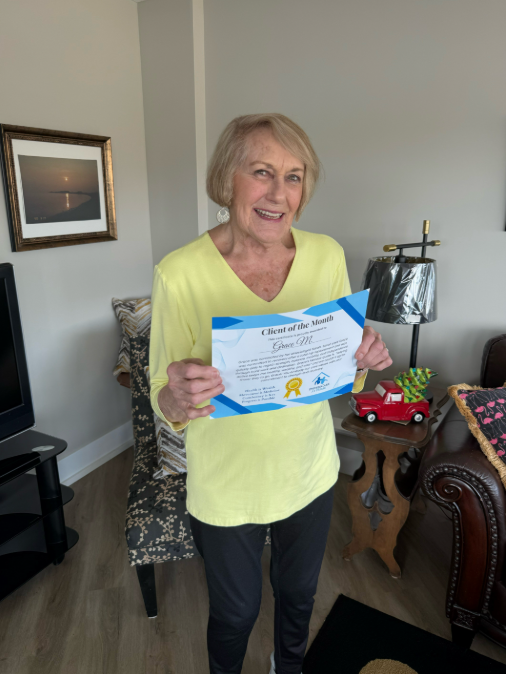
Grace started working with both a physiotherapist and kinesiologist after her total hip replacement. She was a rockstar from the beginning, always ready to exercise and always willing to challenge herself. She quickly gained strength in her hip and regained her independence, showing that Progress is Possible. Grace understands the importance of strength training as she ages and decided to continue her kinesiology sessions to focus on full-body strength, balance and mobility, proving that Consistency is Key. “I feel better… I have so much more energy, and it has allowed me to do what I want in my day. Staying active keeps me motivated and allows me to stay busy and independent.” — Grace
Client Spotlight: June

After June had her total knee replacement, she began working hard with her physiotherapist. Over the months she consistently performed her exercises, treating her rehab like a job! Even despite some tough setbacks, she pushed through and has seen all her hard work pay off. She achieved a big goal of being able to get in and out of her bathtub, and she can easily get on and off the floor — which she hadn't done in 10 years! Now she can do more of the things she loves, with confidence. June really is a star and has proved time and again that Consistency is Key!
Nutrition Tip
Eating well & staying hydrated after surgery plays a key role in recovery. A balanced diet rich in protein, fruits and vegetables, and healthy fats helps support healing, reduce inflammation, and rebuild strength. Eating well after surgery helps you heal faster, reduce inflammation, maintain muscle, and regain strength and mobility.
1. Prioritize protein. Protein helps repair tissue and rebuild muscle — aim for protein at every meal. Options: eggs, Greek yogurt, chicken, fish, tofu, beans. Think: protein = healing + strength.
2. Load up on fruits & vegetables. Rich in vitamins (especially vitamin C) to support healing — berries, citrus, peppers, broccoli, spinach. Helps with tissue repair and immune support.
3. Include anti-inflammatory foods. Fatty fish (salmon, tuna); nuts, seeds, olive oil; turmeric, ginger. Helps reduce swelling and joint stiffness.
4. Support bone health. Increase calcium through food (dairy, fortified milk, leafy greens) and vitamin D (sunlight, fortified foods, & supplementation).
5. Stay hydrated. Aim for regular fluid intake throughout the day — it supports circulation, healing, and energy.
6. Don't undereat. Your body needs extra calories to heal, especially after surgery.
Recipe of the Month

Salmon remains one of the best foods to eat for an anti-inflammatory diet. Try this Corn, Sweet Potato & Salmon Chowder from the Canadian Heart & Stroke Foundation.